Be a Blog Subscriber
Join thousands of manufacturing leaders and professionals who get the Accelerate blog delivered straight to their inbox




Join thousands of manufacturing leaders and professionals who get the Accelerate blog delivered straight to their inbox


Leaders from the Charles L. Shor Foundation, Ludlow High School, and the Northern Kentucky Chamber of Commerce shared how philanthropic investment and employer engagement are creating a stronger, better-prepared candidate pipeline through an SME PRIME program in Northern Kentucky at SME FUSION.
Read More

At SME FUSION, the Building the AI-Ready Manufacturing Workforce session explored how organizations must prepare technology and talent as one integrated strategy as artificial intelligence reshapes manufacturing skills, transforms employee responsibilities, and redefines workforce preparedness.
Read More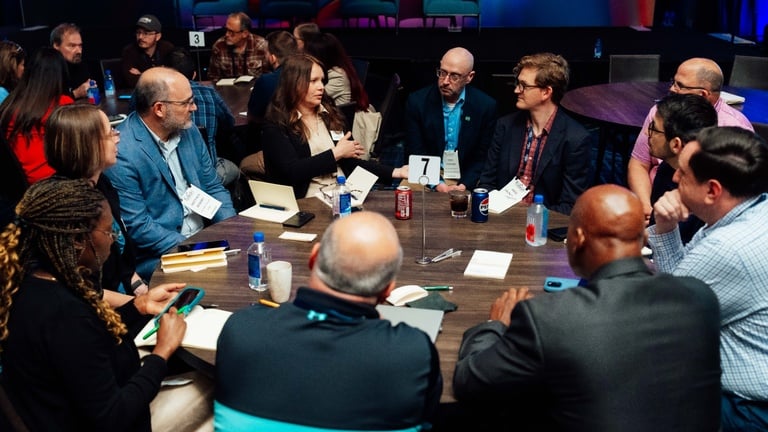

How can we develop strong front-line leaders without disrupting production? A recent session with Toyota Material Handling North America explored an approach combining training, advanced planning, continuous improvement, and follow-ups to help leaders apply new skills on the job.
Read More
Manufacturing labor turnover has changed significantly over the past decade. While voluntary quit rates have declined, workforce turnover remains well above historical levels, continuing to drive hiring costs, extend time to proficiency, and challenge workforce planning.
Read More

At SME FUSION, leaders from A. O. Smith, Northeast State Community College, and Tennessee College of Applied Technology (TCAT) Dickson shared how manufacturers and educators can work together to build stronger workforce pipelines.
Read MoreManufacturers continue to face growing pressure to attract, develop, and retain skilled talent while replacing an aging workforce. At SME FUSION, the session Earn-and-Learn in Practice: A Proven Model for Talent Development showcased how manufacturers and community colleges are building sustainable workforce pipelines through collaborative earn-and-learn programs. Rather than waiting for qualified talent to enter the workforce, these organizations are co-creating it through structured partnerships that combine classroom education with meaningful, paid industry experience.
Speakers
Dr. Patty Weaver, Vice President of External Affairs, Pellissippi State Community College
Jeff Carson, Plant Maintenance Superintendent, McKee Foods Corporation
Jay Easter, Central Services Maintenance Superintendent, Arconic Manufacturing
Elizabeth Hibner, Program Manager, Workforce Development, SME
Traditional hiring often leaves manufacturers hoping that graduates have the skills needed for today's production environments. Instead, these organizations have adopted a co-education model where employers help shape curriculum while students gain real-world experience throughout their education. Students spend two days each week in the classroom and three days working alongside experienced professionals. By graduation, they have earned an associate degree, developed practical technical skills, and accumulated two years of industry experience. For manufacturers, that means hiring candidates they already know and have worked with.
Panelists emphasized that workforce development begins with employer engagement. McKee Foods partnered with its local community college after discovering graduates lacked some of the practical industrial skills needed in the field. An employer-led advisory board became the foundation of the partnership, allowing manufacturers to continually shape curriculum and ensure students learn current technologies and practices.
Students immediately apply classroom concepts inside active manufacturing facilities. From electrical work and troubleshooting to preventive maintenance and engineering projects, every lesson is reinforced through real-world application. Exposure to multiple technical career paths also helps students discover where they thrive before graduation.
Technical skills alone are not enough. Communication, teamwork, professionalism, accountability, and time management were repeatedly identified as critical for long-term success. Close communication between employers and college coordinators allows challenges to be identified early, helping students succeed both academically and professionally.
Employers gain even more than interns. Over two years they evaluate technical ability, work ethic, and cultural fit while students gain valuable experience. By graduation, organizations have a proven pipeline of talent and significantly reduce hiring risk while improving retention.
The panel encouraged manufacturers and colleges to begin outreach in middle schools and high schools. Student ambassadors, facility tours, signing events, and parent engagement all help reshape perceptions of manufacturing careers while showcasing rewarding technical career opportunities.
Pellissippi State Community College has successfully expanded the earn-and-learn approach beyond manufacturing into additional technical disciplines. The speakers emphasized that the model scales through strong partnerships, dedicated coordinators, and active employer participation—not organizational size.
The session concluded with a simple but powerful message: employers and educators must build workforce solutions together. When industry helps shape education and colleges provide structured learning opportunities, students graduate with meaningful experience, employers develop dependable talent pipelines, and manufacturing gains a sustainable strategy for closing the skills gap. For manufacturers looking to develop these types of partnerships, SME can serve as a trusted partner to help identify opportunities, connect the right stakeholders, and get collaborative workforce efforts started. See how SME can help your workforce today.