Be a Blog Subscriber
Join thousands of manufacturing leaders and professionals who get the Accelerate blog delivered straight to their inbox




Join thousands of manufacturing leaders and professionals who get the Accelerate blog delivered straight to their inbox


Discover how Ohio is strengthening its manufacturing workforce through industry partnerships, aligned training, early career awareness and expanded pathways to skilled careers.
Read More
Tooling U-SME helps workers’ compensation insurance providers train sales and underwriting teams to understand manufacturing operations, support safer client practices, and improve long-term insurance outcomes.
Read More
Leaders from the Charles L. Shor Foundation, Ludlow High School, and the Northern Kentucky Chamber of Commerce shared how philanthropic investment and employer engagement are creating a stronger, better-prepared candidate pipeline through an SME PRIME program in Northern Kentucky at SME FUSION.
Read More

At SME FUSION, the Building the AI-Ready Manufacturing Workforce session explored how organizations must prepare technology and talent as one integrated strategy as artificial intelligence reshapes manufacturing skills, transforms employee responsibilities, and redefines workforce preparedness.
Read More
How can we develop strong front-line leaders without disrupting production? A recent session with Toyota Material Handling North America explored an approach combining training, advanced planning, continuous improvement, and follow-ups to help leaders apply new skills on the job.
Read MoreTariffs are increasingly influencing where companies produce, how they invest, which skills they need, and how they build their workforce.
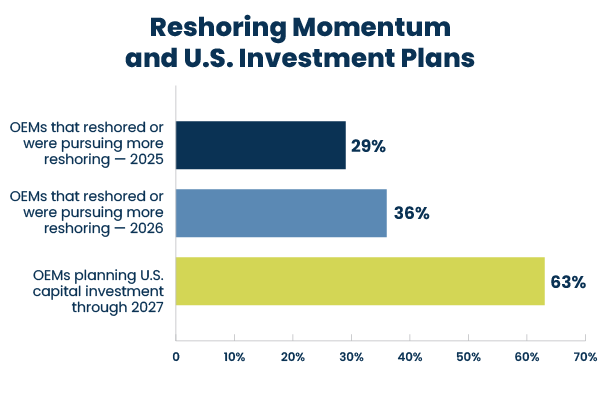
As manufacturers respond to changing trade policies, rising costs, and supply chain uncertainty, reshoring is gaining momentum. In the 2026 USA Reshoring Survey, 36% of U.S. original equipment manufacturers reported that they had reshored or were actively pursuing additional reshoring, up from 29% in 2025. The survey also found that 63% of OEMs planned U.S. capital investment through 2027. [1]
But moving production back to the United States does not automatically create a workforce capable of supporting it. Skilled talent shortages remain a significant obstacle to reshoring, making workforce strategy increasingly important to manufacturing competitiveness.
Here are four ways tariffs could continue shaping the manufacturing workforce through 2027.
1. Reshoring Is Changing Where Talent Is Needed
Tariffs are prompting some manufacturers to reconsider global supply chains and increase domestic production. The 2026 Reshoring Survey found that manufacturers are moving more production and sourcing to the United States, although policy uncertainty, import price competition, and skilled talent shortages continue to limit the pace. [1]
For workforce leaders, this means talent planning needs to increasingly follow production strategy. Companies expanding domestic capacity must consider not only how many people they need, but where they will find skilled technicians, machinists, maintenance specialists, engineers, and other critical talent.
The challenge is significant. The 2026 survey found that 66% of respondents rated hiring technicians, including welders, machinists, and electrical or chemical technicians, as very difficult or at crisis levels. [1]
2. Tariffs Are Increasing the Need for Workforce Agility
Tariff policies and supply chain conditions can change quickly, making long-term workforce planning more difficult. Manufacturers may need to adjust production schedules, suppliers, sourcing strategies, and staffing levels as costs and market conditions shift.
That makes workforce agility increasingly valuable.
Rather than relying exclusively on external hiring, manufacturers can build flexibility by developing employees who can move between roles, operate multiple processes, and adapt to changing production requirements. Cross-training and skills mapping can help companies respond more quickly without starting from scratch every time business conditions change.
3. Automation Is Changing the Skills Manufacturers Need
Tariffs can increase pressure on manufacturers to improve productivity and control costs. One response is greater investment in automation and advanced manufacturing technologies.
The KPMG 2026 Tariff Survey found that 44% of companies surveyed had invested in automation. At the same time, 31% of companies surveyed have hired for specialized roles focused on tariff, trade, and compliance complexity. [2]
The implication for workforce strategy is clear: automation does not eliminate the need for talent. It changes the skills talent needs.
KPMG found that advanced manufacturing and production skills were the most difficult domestic capabilities to find, followed by supply chain and logistics management and engineering and technical design expertise. [3]
Manufacturers increasingly need people who can work with automated systems, analyze data, troubleshoot equipment, manage digital processes, and combine technical expertise with problem-solving skills.
4. Reskilling Could Become a Competitive Advantage
The biggest workforce challenge created by reshoring may not be finding people. It may be training people to have the right skills quickly enough.
A recent ICIS analysis found that tariffs are influencing some companies to reshore manufacturing, but skilled labor shortages could limit the ability to turn those plans into new U.S. production capacity. [4]
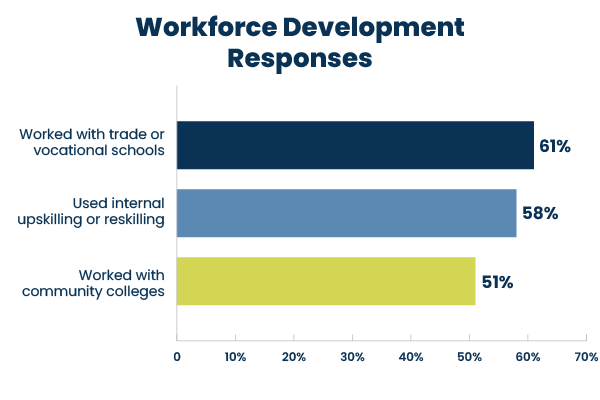
Manufacturers are already responding by increasing their focus on developing existing talent. In the 2026 Reshoring Survey, 58% of respondents reported using internal upskilling or reskilling to address workforce challenges, while 61% reported working with trade or vocational schools and 51% with community colleges. [1]
Instead of competing for a limited pool of experienced talent, manufacturers can develop existing employees for emerging roles in automation, maintenance, quality, logistics, data, and advanced production.
The manufacturing workforce is entering a period in which trade policy, technology, and talent strategy are becoming increasingly interconnected.
Tariffs may encourage domestic investment and reshoring, but the success of those investments will depend in part on whether manufacturers can develop the workforce needed to support them. At the same time, automation and changing production models will continue to alter the skills required across manufacturing.
For manufacturers, the question heading into 2027 may be less about whether tariffs will affect the workforce and more about whether their workforce strategy is prepared for the changes tariffs are accelerating.
Organizations that connect supply chain decisions with hiring, training, reskilling, and technology adoption will be better positioned to turn manufacturing investment into long-term operational capacity.
For manufacturers navigating reshoring, skilled talent shortages, and changing production needs, Talent & Workforce Services can help identify workforce and skills gaps, strengthen training pathways, and build scalable development programs that prepare employees for evolving roles while improving workforce agility and time to proficiency.
[1] Reshoring Initiative and Regions Recruiting. 2026 USA Reshoring Survey: U.S. Reshoring Momentum Builds Despite Policy and Workforce Challenges. August 2026.
2026 USA Reshoring Survey
[2] KPMG. KPMG 2026 Tariff Survey: A Year into Tariffs, U.S. Businesses Navigate Declining Margins as 55% Plan Further Price Increases in the Next Six Months. March 30, 2026.
KPMG 2026 Tariff Survey
[3] KPMG. Tariff 3.0 Survey. 2026.
KPMG Tariff 3.0 Survey
[4] ICIS. So far, US tariffs are falling short of reshoring manufacturing. September 10, 2026.
ICIS analysis of U.S. tariffs and reshoring